
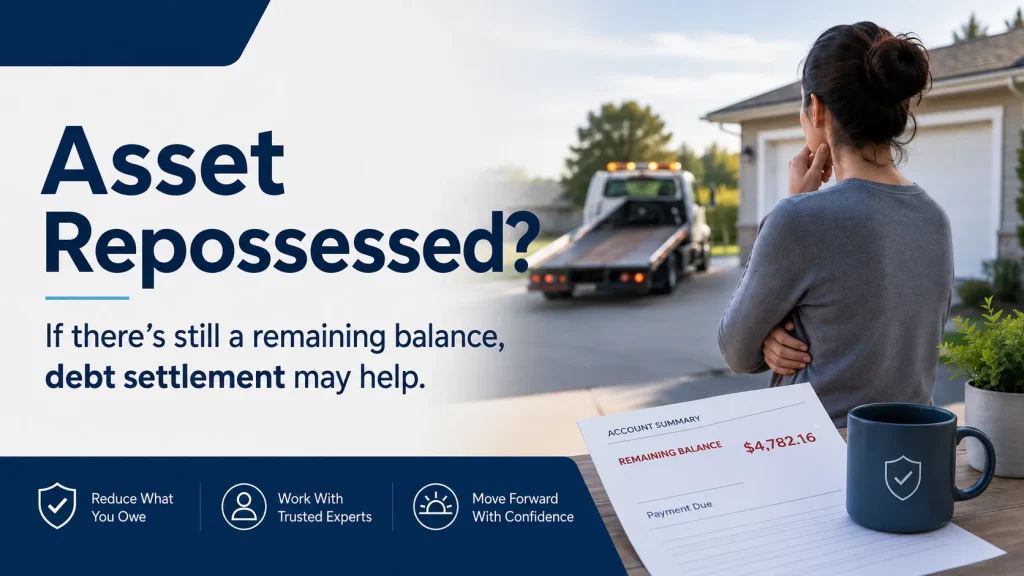
Repossession can feel like one of the most stressful financial events a person can go through.
You lose the car, truck, motorcycle, equipment, or other financed asset, and many people assume that once the lender takes the property back, the debt is over.
Unfortunately, that is not always how it works.
In many cases, after an asset is repossessed, the lender sells it at auction or through another sale process. If the asset sells for less than the amount owed on the loan, the borrower may still be responsible for the remaining balance.
This remaining balance is often called a deficiency balance.
That means the asset can be gone, but the debt can still remain.
At DebtConquest, we want people to understand the difference between the repossession itself and the balance that may still be owed afterward.
This is important because once the asset has already been repossessed and there is still a pending balance, that remaining balance may become something that can potentially be resolved through a debt settlement program.
Debt settlement is not for every situation. But if the car or asset has already been taken and the remaining balance is now being collected, settlement may be one of the practical options to consider.
What Is Repossession?
Repossession happens when a borrower falls behind on payments for a secured loan and the lender takes back the property that was used as collateral.
Common examples include:
- Cars
- Trucks
- Motorcycles
- Boats
- Business equipment
- Other financed assets tied to a secured loan
A secured loan means the lender has a legal interest in the asset. If the borrower does not make the required payments, the lender may have the right to take the asset back, depending on the contract and state law.
Repossession laws can vary by state. Some states require notices, waiting periods, or specific sale procedures. Other states may allow lenders to move faster.
This is why it is important to review your loan documents and speak with a qualified professional if you are unsure about your rights.
But from a financial standpoint, the big thing to understand is this:
Repossession does not always erase the debt.
What Happens After the Asset Is Repossessed?
After repossession, the lender usually tries to sell the asset. In many cases, the asset is sold at auction. The sale proceeds are then applied to the loan balance.
Here is a simple example:
- You owe $18,000 on a car loan.
- The car is repossessed.
- The lender sells the car for $11,000.
- After fees, auction costs, and other charges, there may still be a balance left.
That remaining balance may become your responsibility.
This is the part many people do not realize. They think:
“They took the car, so I should not owe anything anymore.”
But if the sale does not cover the full loan balance, the lender may still pursue the difference.
That difference is the deficiency balance.
What Is a Deficiency Balance?
A deficiency balance is the amount left over after the repossessed asset is sold and the sale proceeds are applied to the loan.
The balance may include:
- Remaining principal
- Late fees
- Repossession fees
- Storage fees
- Auction fees
- Legal fees
- Other costs allowed under the contract or law
This balance can be frustrating because the borrower no longer has the asset, but still has a debt connected to it.
If the balance is not paid, the lender may try to collect it directly. In some cases, the account may be charged off and sent or sold to a collection agency.
Once the deficiency balance becomes a collection account, it can continue creating stress and credit damage.
How Repossession Can Affect Your Credit
Repossession can hurt your credit in several ways.
First, the missed payments leading up to repossession may already be on your credit report. These may include 30-day, 60-day, 90-day, or even longer late payments.
Second, the repossession itself may appear as a serious negative item.
Third, if a deficiency balance remains unpaid and goes to collections, that collection account may create another negative item.
So one repossession situation can create multiple layers of credit damage:
- Late payments
- Repossession notation
- Charge-off
- Collection account
- Possible lawsuit or judgment, depending on the situation
This is why ignoring the remaining balance is risky. Even though the asset is already gone, the financial problem may not be finished.
Can a Repossession Balance Be Settled?
This is where debt settlement may become relevant.
If the asset has already been repossessed and there is a remaining balance, that deficiency balance may be treated like a debt that can potentially be negotiated.
The key condition is this:
Debt settlement applies to the remaining balance after the asset has already been repossessed, not to the asset itself.
In other words, if you are still in possession of the car or asset and trying to keep it, that is a different situation. You may need to speak with the lender about reinstatement, payment arrangements, refinancing, or other options.
But if the asset is already gone and the lender or collection agency is now trying to collect the remaining balance, settlement may be an option.
Debt settlement is the process of negotiating with the creditor or collector to resolve the debt for less than the full balance owed.
The goal is to reach an agreement where the creditor accepts a reduced amount as settlement of the account.
There are no guarantees. Creditors do not have to accept a settlement. Results depend on the creditor, the age of the account, the balance, the hardship, the collection status, and the person’s overall financial situation.
But when someone has a repossession deficiency balance, collection account, or charged-off unsecured debt they cannot realistically afford to pay in full, debt settlement may be one of the most practical ways to resolve it.
When Debt Settlement May Make Sense After Repossession
Debt settlement may be worth considering if:
- The asset has already been repossessed
- You no longer have the vehicle or property
- A remaining balance is still owed
- The lender or collector is demanding payment
- The account is charged off or in collections
- You cannot afford to pay the full balance
- You want to work toward resolving the debt instead of ignoring it
This is especially important if the collector is contacting you, threatening legal action, or reporting the balance on your credit report.
A settlement may help you move from an unresolved debt to a resolved account. It does not erase the fact that the repossession happened, and it does not guarantee a credit score increase.
But resolving the balance may be better than letting the debt sit open, grow, or continue to create collection pressure.
What If the Asset Has Not Been Repossessed Yet?
If the asset has not been repossessed yet, the situation is different.
Debt settlement is not usually the first strategy if your goal is to keep the asset. In that case, you may want to explore options such as:
- Catching up on missed payments
- Asking for a hardship plan
- Refinancing, if possible
- Selling the asset before repossession
- Voluntary surrender
- Speaking with a consumer attorney or financial counselor
If you still have the asset and want to keep it, talk to the lender quickly. The earlier you communicate, the more options you may have.
But once the asset has already been repossessed and a remaining balance exists, the focus changes.
Now the issue becomes resolving the leftover debt.
Do Not Ignore a Repossession Balance
Ignoring a deficiency balance can make things worse.
The account may be transferred to collections. A collector may contact you repeatedly. The balance may continue to appear on your credit report. In some cases, the creditor or collector may file a lawsuit.
If you receive legal papers, do not ignore them.
Debt settlement companies do not replace legal advice. If you are sued, speak with a qualified attorney right away.
The most important thing is to know what you owe, who owns the account, and what options are available.
How DebtConquest Can Help You Understand Your Options
DebtConquest helps consumers understand debt, credit, and settlement options in plain English.
If your car or asset has already been repossessed and you still have a remaining balance, you may not have to simply sit with that debt forever.
Depending on your situation, the deficiency balance may be eligible for a debt settlement strategy.
Debt settlement may help you resolve the remaining balance for less than the full amount owed, if the creditor or collector agrees.
Again, this applies when:
- The asset has already been repossessed
- There is still a pending balance
- The balance is being collected
- You cannot realistically afford to pay the full amount
Call to Action
If your asset has already been repossessed and you still owe a remaining balance, do not ignore it.
That remaining balance may be something that can be settled.
DebtConquest can help you understand whether debt settlement may be a practical option for your situation.
The goal is to help you stop guessing, understand the balance, and see whether there is a path to resolving the debt.
Take the next step today. Learn your debt settlement options and find out whether your repossession balance may qualify for settlement.