
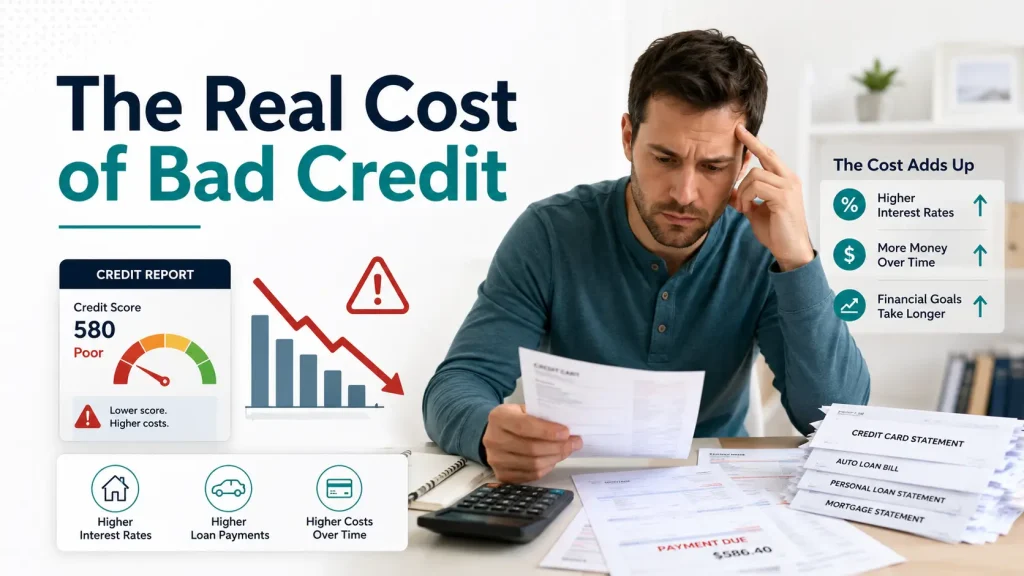
Bad credit can cost you money in ways that are not always obvious.
Most people know bad credit can make it harder to get approved for loans or credit cards. But the real cost can go much deeper than a simple approval or denial.
Bad credit can affect your interest rates, monthly payments, security deposits, housing options, car financing, insurance costs, and even your ability to respond to emergencies. It can make everyday life more expensive and reduce the number of choices you have when you need help the most.
That is why bad credit is not just a credit report problem.
It can become a cash flow problem.
When credit gets damaged, lenders may see you as higher risk. If they approve you, they may charge more. If they deny you, you may be forced to use more expensive alternatives. Either way, the cost can add up over time.
The goal of this guide is to help you understand the real cost of bad credit, why it matters, and what steps may help you begin moving toward better financial options.
Bad Credit Can Lead to Higher Interest Rates
One of the biggest costs of bad credit is higher interest.
When lenders review an application, they often use your credit history to estimate risk. If your credit profile shows late payments, high balances, collections, charge-offs, or other negative items, the lender may believe there is a higher chance that repayment could become difficult.
To protect themselves, lenders may charge a higher interest rate.
That higher rate can make the same purchase much more expensive.
Higher interest increases your monthly payment
A higher interest rate can raise your monthly payment.
This matters because a higher payment can put more pressure on your budget. If your income is already stretched, that extra pressure can make it harder to keep up with other bills.
For example, two people may finance the same car. One person has stronger credit and qualifies for a lower rate. The other person has weaker credit and receives a higher rate.
The car may be the same.
The loan amount may be similar.
But the person with weaker credit may pay more every month and more over the life of the loan.
Higher interest slows your progress
Higher interest also means more of your payment goes toward the cost of borrowing instead of reducing what you owe.
This can feel frustrating. You make the payment, but the balance does not move down as quickly as expected.
That is especially painful with credit cards, where high interest can keep people stuck in the same balance range for months or years.
Bad Credit Can Make Borrowing More Expensive
Bad credit does not always prevent you from borrowing. Sometimes it allows you to borrow, but only on worse terms.
That can be dangerous because an approval can feel like a solution when it may actually create a new problem.
A loan with a high interest rate, high fees, short repayment term, or strict conditions may give temporary relief while creating long-term pressure.
You may qualify for less favorable loans
When your credit is damaged, you may have fewer lenders willing to approve you.
That can push you toward products with higher costs.
These products may include:
- Higher-interest credit cards
- Higher-interest personal loans
- Expensive auto financing
- Secured cards with fees
- Short-term loans
- Loans with larger down payment requirements
The issue is not only whether you can get approved. The issue is whether the approval actually helps you.
Expensive credit can create a new cycle
If you use expensive credit to solve a cash flow problem, the new payment can make your budget even tighter.
Then, if another emergency happens, you may need to borrow again.
This can create a cycle where debt keeps growing and options keep shrinking.
Bad Credit Can Increase Security Deposits
Bad credit can affect more than loans.
Some landlords, utility companies, cell phone providers, and service companies may review your credit before offering service or setting deposit requirements.
If your credit profile appears risky, they may ask for a higher deposit.
Housing deposits may be higher
When applying for an apartment or rental home, a landlord may review your credit history.
A weak credit profile can make it harder to get approved. If you are approved, you may be asked for a larger security deposit, additional rent upfront, or a co-signer.
That can make moving more expensive.
For someone already struggling with debt, coming up with extra money upfront can be difficult.
Utility deposits may be required
Utility companies may also require deposits from people with weaker credit profiles.
This can include electricity, gas, water, internet, or phone service.
A deposit may eventually be refundable, but it still ties up money you may need for other expenses.
Bad Credit Can Limit Your Options
One of the most frustrating parts of bad credit is not just the cost. It is the lack of options.
When your credit is strong, you may have choices. You may be able to compare lenders, shop for better rates, negotiate terms, or choose the product that fits your life.
When your credit is weak, your options may become limited.
You may have fewer lenders to choose from
Some lenders may deny the application immediately.
Others may approve only with higher rates or stricter terms.
This can leave you feeling like you have to accept whatever is offered, even if the terms are not ideal.
You may lose negotiating power
Strong credit can give you more leverage.
Weak credit can reduce that leverage.
For example, if you are financing a car and only one lender approves you, it may be harder to negotiate. If several lenders are competing for your business, you may have more room to choose.
Emergencies become harder to handle
Credit is often most important when something unexpected happens.
A car breaks down. A medical bill appears. A family emergency happens. Income drops. A home repair cannot wait.
If your credit is damaged, your emergency options may be more limited and more expensive.
That can turn one problem into several problems.
Bad Credit Can Affect Housing
Housing is one of the most important areas where credit can matter.
A landlord may use credit information to decide whether you are likely to pay rent on time. They may also look for past evictions, collections, unpaid utility bills, or other financial warning signs.
Bad credit does not automatically mean you cannot rent, but it can make the process harder.
You may need a co-signer
Some landlords may require a co-signer if they are concerned about your credit.
This can create stress because not everyone has someone willing or able to co-sign.
A co-signer also takes on risk, so it can affect relationships.
You may need more money upfront
A landlord may ask for a larger deposit or additional rent upfront.
This can make it harder to move, even if you can afford the monthly rent.
You may have fewer rental choices
Some properties may have strict credit requirements.
If you do not meet those requirements, you may need to look at fewer available options. That can affect where you live, commute time, school options, and overall quality of life.
Bad Credit Can Affect Car Financing
For many people, a car is not a luxury. It is necessary for work, family responsibilities, school, medical appointments, and daily life.
When credit is damaged, car financing can become more expensive.
The same car can cost much more
A higher interest rate can significantly increase the total cost of a car loan.
Even if the monthly payment seems manageable, the total amount paid over time may be much higher.
That means bad credit can quietly take money from your future income.
You may need a larger down payment
Some lenders may require more money down if your credit is weak.
This can be hard if you are already short on savings.
You may be pushed into a worse deal
When options are limited, people may feel pressured to accept a car loan that does not truly fit their budget.
That can lead to late payments, repossession risk, and even more credit damage.
Bad Credit Can Affect Insurance and Service Costs
Depending on where you live and the type of service, credit-related information may affect pricing or deposit requirements.
This can surprise people because they may not connect credit history with everyday bills.
Some costs may be higher
A weaker credit profile may lead to higher costs for certain services or products.
This can make monthly expenses harder to manage.
Small increases can add up
Even small increases matter when they happen across multiple areas of life.
A higher phone deposit, higher utility deposit, higher interest rate, and higher insurance cost can combine into a serious financial burden.
Bad credit often becomes expensive because the costs stack.
Bad Credit Can Create Emotional Stress
The cost of bad credit is not only financial.
It can also create emotional stress.
When credit problems grow, many people feel embarrassed, anxious, frustrated, or overwhelmed. They may avoid opening mail, answering phone calls, checking accounts, or applying for things they need.
That stress can affect decision-making.
Stress can lead to avoidance
Avoidance is common when money feels overwhelming.
But avoiding the problem usually makes it worse. Missed payments, late fees, collection activity, and growing balances can continue even when you are not looking.
Stress can make choices feel urgent
When people feel trapped, they may rush into decisions without fully understanding the consequences.
That is why education matters. Understanding your options can help you make calmer, more informed decisions.
Financial pressure can affect daily life
Bad credit can affect sleep, focus, relationships, confidence, and your sense of control.
This is why the real cost of bad credit is not just a number. It can affect how you feel about your future.
Bad Credit and the Debt Cycle
Bad credit and debt often feed each other.
High debt can damage credit. Damaged credit can make borrowing more expensive. More expensive borrowing can make debt harder to repay.
That cycle can be difficult to break without a clear plan.
High balances can hurt your credit profile
When credit card balances are high, your utilization may increase.
High utilization can make you look more financially stretched. That can affect your credit profile and borrowing options.
Missed payments can create long-term problems
If debt payments become unaffordable, missed payments may happen.
Late payments can affect your credit profile and may lead to fees, account closures, charge-offs, or collections.
Collections can reduce options
Once an account goes to collections, borrowing may become harder and more expensive.
You may also face more calls, letters, settlement offers, or legal concerns, depending on the situation.
How to Start Reducing the Cost of Bad Credit
Improving your situation starts with understanding the full picture.
You do not need to fix everything in one day. But you do need to know what you are dealing with.
Step 1: Review your credit reports
Look at what is being reported.
Check for:
- Incorrect balances
- Accounts you do not recognize
- Duplicate collections
- Outdated information
- Late payments
- Charge-offs
- Collection accounts
If something is inaccurate, you may have the right to dispute it with the credit bureaus.
Step 2: List your debts
Write down each debt, balance, payment, interest rate, and status.
This helps you understand whether the main problem is credit reporting, cash flow, debt amount, or all of the above.
Step 3: Protect current accounts
If you still have accounts in good standing, try to protect them.
On-time payments can help stabilize your credit profile over time.
Step 4: Reduce balances where possible
If you can safely reduce high credit card balances, that may help improve your overall financial picture.
But make sure you still have enough money for essentials.
Step 5: Avoid expensive new debt
When credit is damaged, new debt can be expensive.
Before accepting any offer, look at the total cost, not just the monthly payment.
Step 6: Review your options carefully
Depending on your situation, you may need to explore budgeting, creditor hardship programs, credit counseling, consolidation, or settlement education.
The right path depends on your income, debt, credit condition, and ability to keep up with payments.
The Real Question to Ask
The real question is not only:
“What is my credit score?”
The better question is:
“How much is my credit situation costing me?”
If bad credit is causing higher payments, worse terms, bigger deposits, fewer choices, and more stress, then it is affecting more than your report.
It is affecting your financial life.
Once you understand that, you can begin making a better plan.
Use DebtConquest to Understand Your Credit and Debt Options
DebtConquest was created to help people understand credit card debt, bad credit, cash flow, payments, and possible debt options.
Bad credit can feel discouraging, but understanding the cost is the first step toward making better decisions.
The goal is not to shame yourself for past mistakes. The goal is to see the numbers clearly and decide what to do next.
Start by reviewing your debts, your monthly payments, your credit situation, and your cash flow.
Then ask:
“Is my current plan helping me move forward, or is it keeping me stuck?”
Final Thought
Bad credit can be expensive, but it does not have to define your future.
When you understand the real cost, you can stop guessing, start planning, and begin moving toward better financial options.