
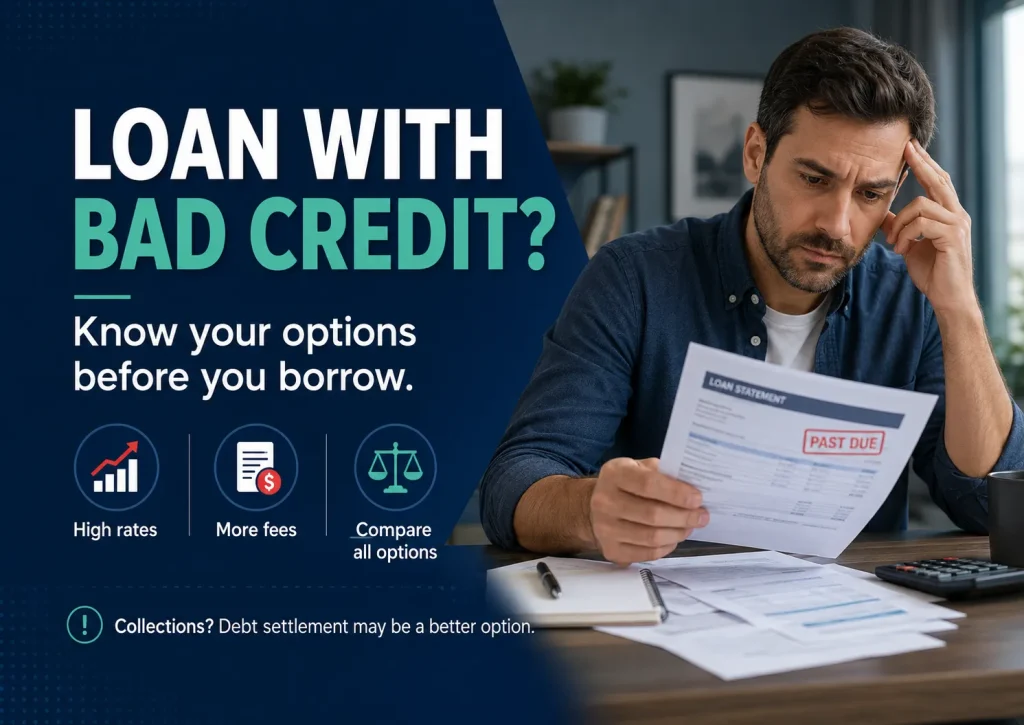
Loan With Bad Credit: What to Know Before You Borrow
Why People Look for Loans With Bad Credit
When debt becomes stressful, many people start looking for a loan. The idea makes sense at first. One loan could pay off several cards, reduce the number of bills, and make the month feel simpler.
When someone is tired of juggling minimum payments, calls, fees, and due dates, a loan can look like a clean solution.
But when your credit is already damaged, the loan offers available to you may not be the offers that actually help.
A loan with bad credit often comes with high interest, fees, shorter repayment terms, or payments that are still too high for the budget.
One Payment Does Not Always Mean Less Debt
Consolidation can be useful when the interest rate is lower, the payment is affordable, and the borrower has stopped creating new debt.
But if the loan has a high rate, it may only move the debt from one place to another.
This is the mistake many people make. They focus on having one payment, but they do not calculate the total cost.
A payment can be easier to track and still be expensive.
The real question is whether the loan helps you get out of debt or simply restarts the clock.
The Risk of High-Interest Consolidation
High-interest consolidation can trap people because it creates the feeling of progress without solving the cause of the debt.
If the new loan pays off the cards but the budget is still short, the cards may get used again.
Now the person has the consolidation loan plus new credit card balances.
This is how debt can multiply. The borrower tried to solve the problem, but the loan did not fix the cash flow issue. It only created another account to pay.
What to Check Before Taking a Loan
Before accepting a loan, review the interest rate, fees, monthly payment, payoff term, total repayment amount, and whether there is a prepayment penalty.
Also ask yourself whether the payment fits your budget without using credit cards again.
If the payment only works in a perfect month, it may not be safe. Real life includes repairs, medical costs, family emergencies, and income changes.
A debt solution should work in reality, not just on paper.
Bad Credit Can Limit Your Options
People with strong credit usually get better rates. People with bad credit often get fewer choices. That is why borrowing with bad credit can be expensive.
The lender is pricing the risk into the loan.
This does not mean every bad credit loan is wrong, but it does mean you should be careful.
A loan should reduce pressure, not add more pressure.
When a Loan May Not Be the Best Solution
A loan may not be the best solution if your debts are already charged off, in collections, or unaffordable.
At that stage, the main problem is not the number of payments. The main problem is unresolved debt that you cannot realistically pay in full.
If you already have collection accounts, a debt settlement program may be the better option to review.
Settlement focuses on negotiating eligible unsecured debts for less than the full balance when possible. Instead of borrowing more money, the goal is to resolve the existing debt.
Why Debt Settlement May Be Better for Collection Accounts
When an account is already in collections, the original credit damage may have already happened.
Taking a high-interest loan to pay a collector in full may not be the most efficient path if the loan creates years of new payments.
Debt settlement may give consumers a structured way to address collection accounts.
It can help organize the process, communicate with creditors or collectors, and work toward settlements that the consumer approves.
It is not instant, and there can be risks, but it may fit the situation better than another loan.
Questions to Ask Yourself
- Can I afford the loan payment and still cover rent, food, utilities, transportation, and emergencies?
- Will this loan lower my total cost, or only lower my stress temporarily?
- Are my accounts current, or are they already in collections?
- Do I need payoff, consolidation, or settlement?
These questions matter because the right solution depends on where you are.
A current account strategy is different from a collection account strategy.
DebtConquest Perspective
A loan with bad credit can sometimes help, but it can also keep you in the cycle.
Do not let the promise of one payment distract you from the math. Look at the total cost, the interest, and whether the loan actually moves you toward zero.
If your debts are in collections, debt settlement may be a better path to consider because it aims at resolution, not another layer of interest.
The Question Most Loan Ads Do Not Answer
A loan advertisement may focus on speed, approval, or one monthly payment.
But the more important question is this: what happens after the loan is funded?
If the payment is too high or the interest is too expensive, the stress may return quickly.
A true debt strategy should not only get you approved today. It should help you move closer to being done with the debt.
If the loan does not do that, it may not be the right solution.
Compare Loan Cost to Settlement Cost
Before taking a bad credit loan, compare the total repayment amount to what a realistic settlement strategy might look like for eligible unsecured debts.
This does not mean settlement is automatically better, but it should be compared when accounts are already in collections.
If a loan requires years of high-interest payments, and the debts are already charged off, settlement may be a better conversation because it focuses on resolving the balances instead of financing them again.
Protect Yourself From Desperation Decisions
Desperation can make any approval feel like a rescue.
Slow down before signing. Read the terms. Ask what the total cost will be. Ask whether the payment still works if your income drops or an emergency happens.
If the numbers do not work, that does not mean you failed.
It may mean the debt needs a different solution.
How This Connects to Credit Rebuilding
Credit rebuilding usually starts after the pressure becomes organized. When you know which accounts are current, which accounts are behind, and which accounts are in collections, you can stop treating every debt the same.
That helps you make better decisions and avoid wasting money on strategies that do not fit your situation.
The purpose of resolution is not only to close an account. It is to create room for the next stage.
Once unsecured debts are addressed, many people can focus on budgeting, rebuilding savings, monitoring credit reports, disputing inaccurate information, and creating better borrowing habits.
The path is not instant, but it becomes clearer when the old debt has a plan.
For DebtConquest, the message is simple: do not confuse movement with progress.
A new loan, a minimum payment, or a promise to catch up later is only progress if it actually moves you closer to stability.
If the debt is in collections, resolving the account through a debt settlement program may be a better step than trying to stretch the balance for years.
Simple Action Plan
Write down the account names, balances, status, and monthly payments.
Then mark each account as current, late, charged off, or in collections.
This gives you a working map of the problem instead of a pile of stressful information.
After that, decide which path fits each group.
- Current debts may need budgeting and payoff.
- Inaccurate items may need disputes.
- Collection accounts may need settlement review.
This keeps the strategy practical and prevents one-size-fits-all advice from pushing you into the wrong solution.
Educational Disclaimer
This article is for educational purposes only and is not financial, legal, or tax advice.
Loan terms vary, and debt settlement may not be right for everyone. Settled debt may have tax consequences, and missed payments can affect credit.
Review your situation carefully before choosing a path.