
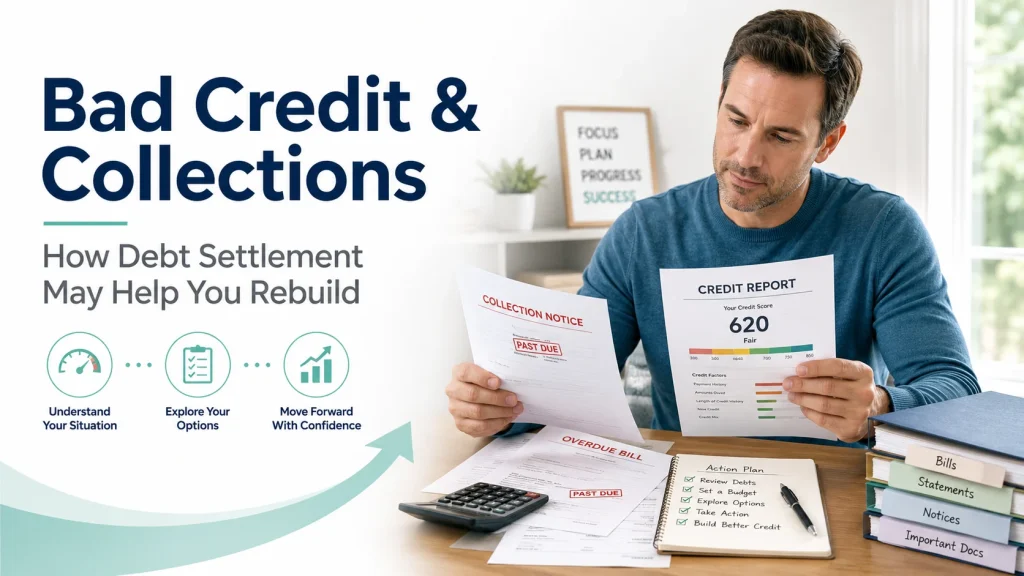
Bad credit can feel discouraging.
But when you already have accounts in collections, charge-offs, late payments, or credit cards that you can no longer afford, the situation can feel even heavier.
At that point, many people are not asking basic questions like:
“How do I build perfect credit?”
They are asking more urgent questions:
- “What do I do now?”
- “Can my credit ever recover?”
- “Should I keep paying minimums?”
- “Should I settle these debts?”
- “How do I start moving forward?”
If you already have bad credit and debts in collections, the goal is not to pretend nothing happened. The goal is to understand where you are, what is hurting your credit, and what steps may help you start repairing the damage.
For many people in this situation, unresolved debt is one of the biggest problems.
A debt that is sitting in collections may continue creating stress, collection calls, letters, possible settlement offers, and sometimes legal risk. Even if your credit score is already damaged, unresolved accounts can keep you stuck because they show lenders that old debt is still open, unpaid, or unresolved.
This is where debt settlement may become part of the conversation.
Debt settlement is not the right fit for everyone. It can have serious consequences, including credit impact, possible collection activity, fees, and possible tax consequences. But for people who are already behind, already in collections, and unable to realistically repay the full balances, settlement may help resolve debts for less than the full amount owed.
That can be an important step toward rebuilding.
The purpose of this guide is to help you understand bad credit, collections, debt settlement, and how resolving old debts may help you begin working toward better credit options over time.
What Bad Credit Really Means
Bad credit usually means your credit history shows signs of financial stress.
That may include late payments, high credit card balances, charge-offs, collections, repossessions, defaults, or other negative information. To lenders, these items can suggest that you may be a higher-risk borrower.
But bad credit does not mean you are a bad person.
Many people end up with damaged credit because life became financially overwhelming. A job loss, medical issue, divorce, business failure, reduced hours, inflation, family emergency, or unexpected expense can push someone behind.
Once you fall behind, catching up can be difficult.
Bad credit is usually a history problem
Your credit report tells a story about how accounts have been handled over time.
If that story includes missed payments, unpaid balances, or collection accounts, lenders may become cautious.
Bad credit is also a cash flow problem
Bad credit is not just about the report.
It often connects to your monthly budget. If you cannot afford your payments, the credit damage may continue until the underlying debt problem is addressed.
Bad credit can limit your options
When your credit is damaged, you may face higher interest rates, denials, larger deposits, lower credit limits, and fewer borrowing choices.
That is why resolving the debt problem matters.
What It Means When Debt Goes to Collections
Debt usually goes to collections after the original creditor believes the account is seriously past due.
The original creditor may continue trying to collect, assign the account to a collection agency, or sell the debt to a debt buyer. Once this happens, you may receive letters, phone calls, emails, or settlement offers.
A collection account can be stressful because it means the debt has moved into a more serious stage.
Collections show unresolved debt
A collection account can tell lenders that an old debt has not been fully resolved.
Even if your credit score is already low, unresolved collections may continue to make your financial situation look risky.
Collections can create pressure
Collection activity can create emotional stress.
You may feel pressure from calls, letters, deadlines, or threats of further action. In some cases, depending on the debt and the laws in your state, a collector or creditor may sue to collect.
Collections do not disappear just because you ignore them
Avoiding the debt may feel easier in the moment, but it usually does not solve the problem.
The balance may remain unpaid, the account may continue reporting, and the stress may continue.
Why Unresolved Debt Can Keep You Stuck
When you already have bad credit, it is easy to think:
“My credit is already damaged, so what difference does it make?”
But unresolved debt still matters.
Even if the damage has already happened, unpaid debts can continue affecting your financial life. They may limit your ability to rebuild, create future collection activity, and make it harder to show progress.
Lenders may see unpaid collections as a warning sign
Some lenders may look beyond the score.
They may review whether old debts are paid, settled, unresolved, or still actively collecting. An unpaid collection can raise concerns because it shows an old obligation has not been handled.
Open collection accounts can create uncertainty
Unresolved accounts can leave you wondering what will happen next.
Will they call again? Will they send another letter? Will they offer a settlement? Will they sue? That uncertainty can make it hard to feel in control.
You may need a clean starting point
Rebuilding often becomes easier when you know which debts are resolved, which debts are active, and which debts still need a plan.
Settlement can sometimes help create that starting point.
What Debt Settlement Means
Debt settlement is when a creditor, collector, or debt buyer agrees to accept less than the full balance owed to resolve the debt.
For example, if you owe $10,000, the collector may agree to accept $5,000 as settlement, depending on the situation. The exact amount depends on many factors, including the creditor, debt age, account status, hardship, available funds, and negotiation.
Debt settlement is commonly discussed when someone cannot afford normal repayment.
It is not the same as debt consolidation, credit counseling, bankruptcy, or minimum payment repayment.
Debt settlement focuses on resolving the debt
The goal of settlement is to resolve the account so it is no longer sitting as an unpaid balance.
This can help you move from “unresolved debt” toward “settled debt.”
Debt settlement may reduce what you owe
A settlement may allow you to resolve a debt for less than the full balance.
That can matter when the full amount is not realistic.
Debt settlement can have consequences
Debt settlement can affect your credit, especially if you are not already behind.
It may involve collection activity, creditor calls, account closures, fees, and possible tax consequences if forgiven debt is considered taxable. You should speak with a qualified tax professional about your specific situation.
Can Debt Settlement Help Improve Credit Faster?
This is the key question.
Debt settlement does not magically fix credit overnight. It also does not erase the past. Late payments, charge-offs, and collections may still remain on your credit report for a period of time.
But if you already have bad credit and debts in collections, resolving those debts may help you begin rebuilding sooner than staying stuck with unpaid accounts.
That is the important distinction.
Settlement can help resolve open collection balances
An unpaid collection shows unresolved debt.
A settled collection may show that the account has been resolved for less than the full amount. That does not make the history perfect, but it may be better than leaving the account unpaid indefinitely.
Settlement can reduce financial pressure
If settlement reduces the total amount you must pay, it may free up future cash flow.
That money may help you stabilize your budget, avoid new missed payments, build emergency savings, or manage current obligations better.
Settlement can create a rebuilding point
Many people cannot rebuild while old debt is still actively collecting.
Once debts are resolved, you may be able to focus on healthier financial habits, current accounts, secured cards, budgeting, and rebuilding positive payment history.
Settlement is not guaranteed to raise your score immediately
It is important to be honest.
A settled account may not produce an immediate credit score increase. Credit scoring depends on many factors, including what else is on your report, how old the negative accounts are, whether balances update, and whether you have positive active accounts.
But resolving debts may still be an important step toward long-term improvement.
Why Settlement May Make Sense When Debt Is Already in Collections
Debt settlement may make more sense when the debt is already delinquent, charged off, or in collections.
At that stage, your credit has usually already been damaged. The question becomes:
“What is the best path forward from here?”
If you cannot afford to pay the full balance, and the account is already in collections, settlement may offer a realistic way to resolve the debt.
The full balance may not be realistic
Some people owe more than they can reasonably repay.
If the balance is large, interest and fees have grown, and income is limited, paying the full amount may not be practical.
Minimum payments may no longer be available
Once an account is charged off or in collections, you may no longer have the original minimum payment arrangement.
The collector may demand payment, offer a payment plan, or offer a settlement.
A settled account may be better than an unresolved account
From a practical standpoint, a resolved account can give you more clarity than an unpaid collection.
It may not remove the past, but it can help close that chapter.
Debt Settlement vs. Paying in Full
If you can afford to pay a debt in full without hurting your ability to cover essentials, that may be worth considering.
But many people with bad credit and collections cannot afford full repayment.
That is why settlement exists as an option.
Paying in full may look stronger, but it costs more
A paid-in-full collection may look better than a settled account in some situations.
However, paying in full may require more money, which may not be realistic.
Settling may be more practical
Settlement may allow you to resolve the debt sooner and for less money.
If your goal is to stop the account from remaining unresolved, settlement may be a practical path.
The best option depends on your situation
The right choice depends on your income, savings, other debts, creditor behavior, legal risk, and financial goals.
There is no one-size-fits-all answer.
What to Know Before Settling a Debt
Before settling a debt, you should understand the process and protect yourself.
Do not rush into an agreement without clarity.
Get the agreement in writing
Before sending money, ask for written confirmation of the settlement terms.
The agreement should explain the amount being accepted, the account being resolved, the payment deadline, and what happens after payment.
Understand who owns the debt
Sometimes the original creditor owns the debt. Sometimes the debt has been sold to a debt buyer.
You should know who you are paying and what authority they have to settle.
Ask how the account will be reported
A settlement may be reported as settled, settled for less than full balance, paid settled, or similar language.
The exact reporting can vary.
Keep proof of payment
Save the settlement letter, payment confirmation, receipts, and any follow-up letters showing the account was resolved.
Watch for tax issues
Forgiven debt may have tax consequences in some situations.
Speak with a tax professional to understand whether the forgiven amount could be treated as taxable income.
How Debt Settlement Fits Into Credit Rebuilding
Debt settlement is not the entire credit rebuilding plan.
It may be one part of the plan.
After debts are resolved, you still need to build positive credit behavior.
That means focusing on current accounts, payment habits, budget control, and avoiding new debt problems.
Step 1: Resolve old debts strategically
You may not be able to settle everything at once.
Start by listing each debt, balance, collector, account status, age, and whether legal action is a risk.
Step 2: Protect current accounts
If you still have any accounts in good standing, protect them.
Current positive payment history can help your rebuilding process.
Step 3: Avoid creating new collections
Do not settle old debts while ignoring current bills.
The goal is to stop the damage from continuing.
Step 4: Build emergency savings
Even a small emergency fund can reduce the need to rely on credit cards again.
Step 5: Use credit carefully after settlement
Some people rebuild with a secured credit card or small credit-building account.
The key is to keep balances low and pay on time.
Step 6: Monitor your credit reports
After settlement, watch your credit reports to confirm accounts update correctly.
If inaccurate information appears, you may have the right to dispute it.
Mistakes to Avoid When You Already Have Bad Credit
When you already have bad credit, the wrong move can make things worse.
Mistake 1: Ignoring collections completely
Ignoring the problem does not usually make it go away.
It can lead to continued stress, missed opportunities to settle, or possible legal action depending on the account.
Mistake 2: Paying whoever calls first
Not every collector should be paid without verification.
You should understand the account, the owner, the balance, and the agreement before paying.
Mistake 3: Settling without a written agreement
A verbal promise is not enough.
Get the settlement terms in writing before paying.
Mistake 4: Using new high-interest debt to settle old debt
Borrowing expensive money to settle old debt can create a new problem.
Make sure the settlement plan actually improves your overall situation.
Mistake 5: Expecting instant credit repair
Settlement may help resolve debt, but rebuilding credit still takes time.
The goal is progress, not magic.
When Debt Settlement May Not Be the Right Fit
Debt settlement is not always the best option.
If you can afford normal repayment
If you can afford to stay current and pay your balances down, settlement may not make sense.
If the debt is very old
Some debts may be past the legal time limit for lawsuits, depending on your state and the type of debt. You should understand your rights before making a payment or agreement.
If bankruptcy may be more appropriate
For some people, bankruptcy may provide broader protection or a more complete solution.
That is a legal decision, so speak with a qualified bankruptcy attorney if you are unsure.
If you cannot afford the settlement payments
Do not agree to a settlement plan you cannot complete.
If you default on the settlement agreement, you may lose the deal and still owe the debt.
The Real Goal: Resolve, Stabilize, Rebuild
When you already have bad credit and debts in collections, the goal is not perfection.
The goal is progress.
You want to:
- Understand what you owe.
- Resolve what can be resolved.
- Stop new damage.
- Stabilize your cash flow.
- Rebuild positive credit habits.
Debt settlement may help with the first two parts of that process when full repayment is not realistic.
But the rebuilding process also requires discipline after the settlement.
Resolve the past
Unpaid collections can keep you stuck.
Resolving those debts may help you move forward.
Stabilize the present
Your monthly budget must become manageable.
If your cash flow is still broken, new debt problems may appear.
Rebuild the future
Credit rebuilding comes from consistent positive habits over time.
That means paying current accounts on time, keeping balances low, avoiding unnecessary debt, and monitoring your reports.
Use DebtConquest to Review Your Debt Settlement Options
DebtConquest was created to help people understand credit card debt, collections, debt settlement education, cash flow, and possible next steps.
If you already have bad credit and debts in collections, you do not need shame. You need clarity.
Start by reviewing:
- Which debts are still unpaid
- Which accounts are in collections
- Which balances are realistic to settle
- Which accounts may carry legal risk
- How much cash flow you have available
- What your rebuilding plan will look like after settlement
Debt settlement may not erase the past, but it may help you resolve old debts and begin creating a cleaner path forward.
Final Thought
Bad credit does not have to be the end of your financial story.
If your debts are already in collections, resolving them may be one of the most important steps toward rebuilding.
The faster you understand your options, the faster you can stop guessing, create a plan, and begin moving toward better financial control.